Optimizing Inventory Management Across Multiple Warehouse Locations
Discover four essential strategies for multi-location warehouse management. Learn how the right inventory software helps you leverage item tagging, prioritize high-profit stock (ABC classification), maintain accurate records, and reduce costs across all your facilities for efficient, frustration-free inventory control.
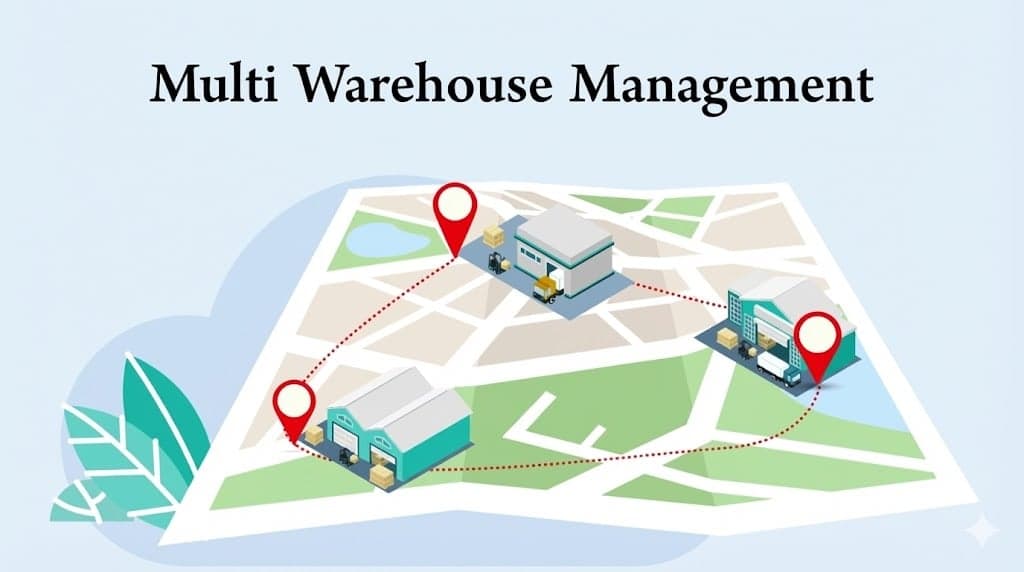
It is widely understood that effective warehouse management software streamlines various facets of inventory control, encompassing everything from stock ordering and product tracking to demand forecasting. For businesses maintaining substantial inventory across several facilities, however, implementing a specialized multiple warehouse inventory management system becomes essential. This piece explores four proven strategies for multi-location warehouse management. We will also demonstrate how the correct warehouse management software is key to making these strategies both efficient to deploy and easy to maintain.
Strategy 1: Leverage Item Tagging and Continuous Tracking
Successful inventory management hinges on two key processes:
- Systematically organizing and labeling (via barcoding or tagging) your stock.
- Maintaining perpetual tracking of every product.
Building an accurate and sustainable inventory control system that spans multiple warehouses requires dedicated attention to both of these elements.
Organizing and Labeling Inventory
The initial phase involves organizing and applying labels to all inventory items. This can be achieved through various methods: utilizing existing product barcodes or QR codes, employing RFID tags, or creating custom barcodes and QR codes for stock that lacks labeling.
While RFID technology is precise, it can be costly and is often unnecessary in warehouse environments with low security risks. Barcode and QR code technology offers a free alternative, particularly when your inventory software allows for the use of a smartphone or tablet as a scanner.
Furthermore, the ability to generate and print bespoke barcodes and QR codes for unlabelled items ensures that every single box on your warehouse shelves is accounted for.
Continuous Inventory Tracking
Once your entire warehouse is labeled, ongoing, perpetual tracking is essential to keep your records current.
This element of inventory control provides visibility into stock levels, identifies which warehouse holds specific products, calculates the capital tied up in unsold goods, signals low stock levels, and monitors the movement of inventory between locations.
Using the appropriate multi-warehouse management software, setting up location-specific folders, including subfolders for aisles and bins, is straightforward. When an item moves, a team member can simply scan a barcode or QR code, drag the item to a new subfolder, and log whether the transfer was internal to the warehouse, to a new warehouse, or due to consumption or sale.
The Integrated System
By diligently labeling your inventory and using those labels for continuous item tracking, you establish a complete, end-to-end management system for multi-location inventory.
Additionally, crucial features such as low stock alerts can notify you when a specific warehouse is running low on a product. This is particularly vital for closely monitoring your fastest-moving inventory, the high-demand, quick-selling products that drive significant profit.
Strategy 2: Prioritize High-Profit, Best-Selling Items
For businesses finding the prospect of a multi-location inventory strategy daunting, a practical starting point is the ABC classification method. This system categorizes stock into three groups:
- Category A: 20% of stock, generating 70% of profits.
- Category B: 30% of stock, generating 25% of profits.
- Category C: 50% of stock, generating 5% of profits.
The underlying principle is clear: your highest-profit items are the most critical, and preventing stockouts should be the top priority. Given their high revenue contribution, it is logical to apply the most rigorous inventory control measures to these particular items.
If your company's resources are currently insufficient to manage every item in every warehouse flawlessly, begin by establishing a robust inventory management system specifically for the few products that yield the highest revenue.
To enhance both profitability and productivity, explore innovative strategies for maximizing sales and profit from these best-sellers. For instance, relocating Category A items to a warehouse geographically nearer to your customer base can lower shipping expenses and delivery times. Another option is to consider a vendor-managed inventory (VMI) agreement, which can tighten operational control and introduce efficiencies across your entire supply chain.
Strategy 3: Maintain Precise and Current Records
The right multi-warehouse inventory management software is instrumental in ensuring data accuracy and maintaining round-the-clock record synchronization, even when dealing with employees operating in various time zones and locations.
Employees equipped with smartphones can check items in and out and manage inter-warehouse transfers. Beyond simply maintaining organization, their actions generate valuable records that your business can leverage for multiple functions, such as preparing a balance sheet, forecasting future demand, liquidating excess inventory, planning sales or promotional events, or sourcing more favorable terms from new suppliers.
Furthermore, these comprehensive records are necessary for tax compliance, claiming depreciation, and executing crucial year-end inventory audits.
Strategy 4: Minimize Expenses Through Strategic Inventory Practices
The final strategy for managing multi-warehouse inventory involves lowering operational costs by effectively utilizing the core features of your inventory management software.
One example is safeguarding profit margins by implementing low stock alerts. Stockouts lead to customer dissatisfaction and often force the purchase of replacement products at a premium price. To mitigate this, set up notifications to proactively monitor dropping inventory levels, expiration dates, preventative maintenance schedules, and warranty expiration, especially for high-value equipment in your warehouses.
Analyzing regional usage patterns is also key to strategically positioning inventory. Optimizing warehouse utilization in this manner can simultaneously reduce shipping expenses and accelerate delivery times, resulting in higher profits and improved customer experiences.
As part of this pattern review, you might consider engaging with new suppliers who are capable of shipping to all your locations. This could lead to volume discounts and simplify complex accounting and receiving procedures.
It is also advisable to require a comprehensive physical audit of all on-hand inventory from every warehouse at least once annually. When aided by warehouse management software, these audits should be relatively non-disruptive, and having verified inventory records on hand significantly reduces the effort and concern associated with placing orders, fulfilling requests, or filing taxes.
During these inventory counts, instruct employees to look out for issues like obsolescence, spoilage, and inventory shrinkage, all of which erode company profits. Should you detect unacceptable inventory loss, it is vital to pinpoint the cause and introduce targeted training or enhanced surveillance in the affected areas.