The Hidden Dangers of "Flexible" Inventory Management: Why Data Integrity Wins in the Long Run
Don't let 'flexible' inventory management sacrifice your business health. Prioritize data integrity, clear audit trails, and protected calculated costs for long-term success.
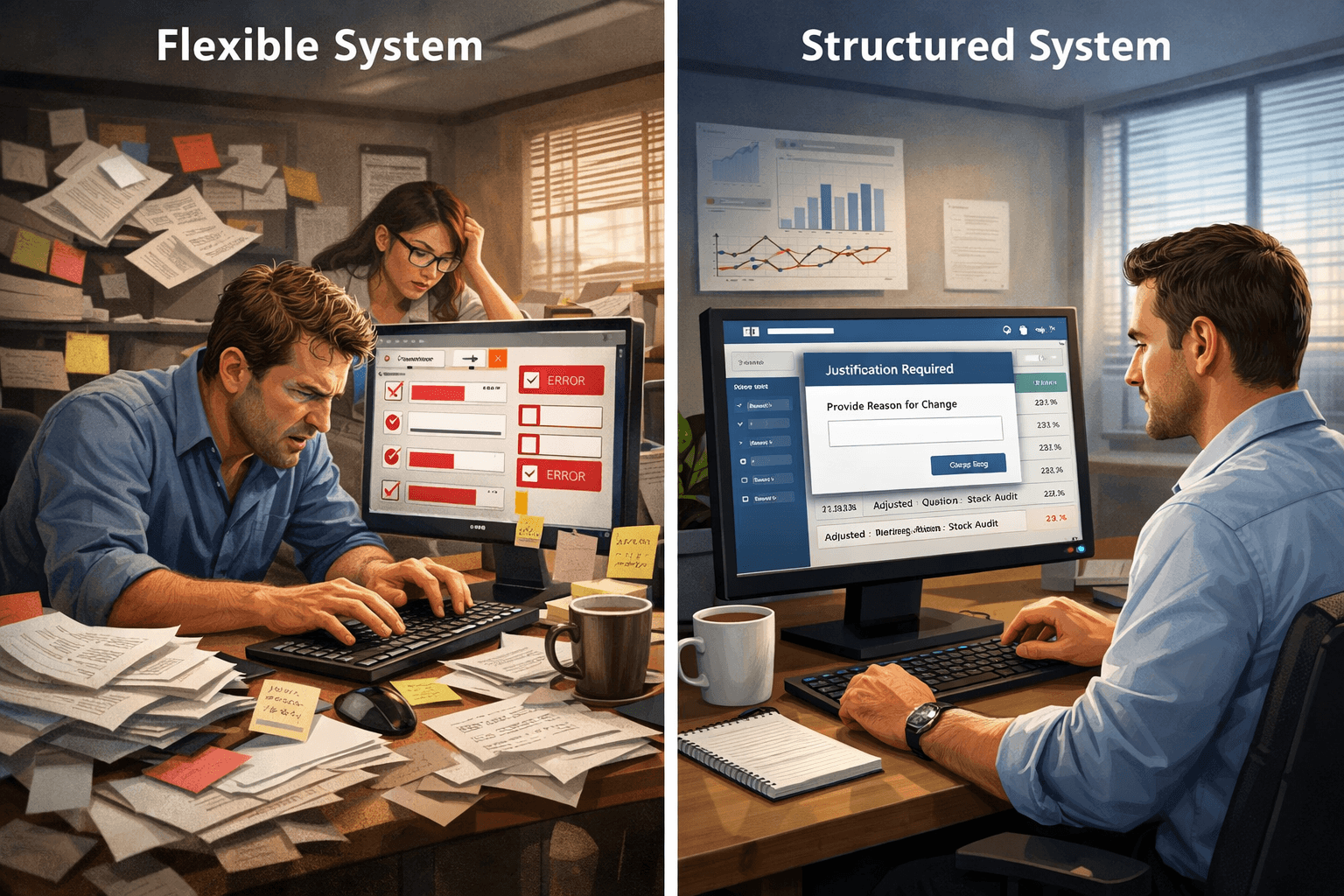
As a product manager for a SaaS inventory management platform, I often find myself in discussions about balancing user flexibility with system integrity. A recent observation from a user sparked a powerful conversation that gets to the heart of this challenge. They noticed that a competitor's system allowed for seemingly limitless flexibility, editing item costs at will, changing quantities without a reason, and even adding products without a cost.
On the surface, this might seem like a great feature. Who doesn't want more control and less friction in their workflow? But as we dug deeper, it became clear that this "flexibility" is a wolf in sheep's clothing, sacrificing long-term business health for short-term convenience.
Our approach, which requires costs to be tied to transactions and quantity changes to be justified, may seem more rigid. But in a world where businesses live and die by their data, this rigor is the very foundation of success.
The Siren Song of Flexibility
So, why would a competitor build a system with such loose controls? The answer often lies in targeting a specific user base: the small business owner or entrepreneur who is new to inventory management. For them, concepts like FIFO/LIFO costing, and detailed audit trails can feel overwhelming.
A system that lets you simply "type in" a new cost or quantity offers a sense of immediate control and speed. It’s a quick fix that prioritizes a seamless user experience above all else. This approach assumes that the user will handle the underlying accounting complexities themselves, or that the business is too small for it to matter.
The Unseen Costs of a "Loose" System
But what happens when that business grows? Or when it’s time to integrate with accounting software like QuickBooks? This is where the competitor's system shows its true colors.
1. A Broken Audit Trail: Imagine trying to understand why your inventory value dropped last month. In a system where costs can be changed without a transaction, the trail goes cold. Was the cost changed due to a new shipment? A supplier price increase? Or was it a simple typo? There’s no way to know. Our system, by tying every cost change to a purchase order or a manual adjustment with a reason, provides a crystal-clear history.
2. Flawed Accounting: The competitor’s system allows users to directly edit the "Average Cost" of an item. This is a fundamental flaw. By its very definition, a weighted average is a calculated value based on all historical transactions, not a user-editable field. When a user can override this, the data becomes untrustworthy and will inevitably lead to discrepancies when reconciling with your accounting ledger.
3. Operational Chaos: Without a required reason for a quantity change, it becomes impossible to track stock-level issues. Why is your count off? Was it damaged goods? A return? Theft? The lack of data makes it impossible to analyze and correct operational inefficiencies. Our system, which requires a reason like "Damaged," "Count Error," or "Returned," provides the vital insights needed to improve business operations.
Why Our Approach is Better for Business
While our system might feel less "flexible" at first glance, it is built on the core principles of financial and operational integrity.
- Costs are derived from reality: An item's cost should always be a reflection of a real-world event—a purchase, a production run, or an adjustment. This ensures your inventory value is always accurate and defensible.
- Every action has a reason: By requiring a reason for every quantity change, we empower managers to gain a deeper understanding of their inventory flow. This isn't just about accounting; it's about business intelligence.
- Calculated values are protected: We prevent users from editing calculated fields like "Average Cost." This protects the integrity of the data and ensures that the system's output is always reliable.
In the end, our platform is not just a tool for tracking items; it's a foundation for building a successful, scalable business. While our competitor's system may offer a quick and easy start, the hidden costs of data inaccuracy and operational confusion will inevitably catch up. We believe that true flexibility lies not in the ability to override rules, but in the power to trust your data completely, allowing you to make smarter decisions and build a business that will thrive in the long run.